
Minimoog
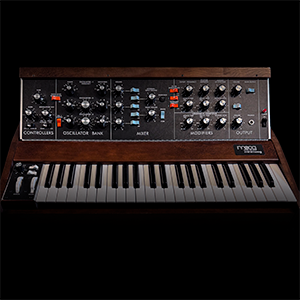
If any instrument in electronic music can be called a classic, it's the Minimoog. It's essentially a Moog Modular in a more compact form factor, with the connections between its elements — oscillators, filter and envelopes — prewired. That simplicity is one of the reasons it became so popular for funk, jazz and dance music of all types, resulting in it remaining in favour even after digital and sampling synths had become flavour of the decade in the 80s. Its popularity has, if anything, increased since. The other reason for its enduring popularity is that it is a triumph of user interface design. Its nearest competitor, the Arp Odyssey, was smaller, lighter and had more features, but the Minimoog's streamlined feature set, its large controls and their intuitive layout together make it a joy to play and tweak in real time — even in the low light conditions of a stage or club.
Classic: It's hard to single out a specific track here — the Minimoog has been on everything from Abba to practically every piece of 90s G-funk. But it's also all over Madonna's first album, which we think includes some of the most perfect pop of the last 50 years — including the bass on Holiday.
Contemporary: Federico Chiesa, who performs as Oora, creates emotive, melodic pieces that inhabit a welcome middle ground between downbeat ambient and upbeat club music. Much of his work is partly improvised, so it's no surprise that he's an advocate of instruments that have limited features but that can be expressively tweaked in performance. This Was Supposed To Be Everything is a perfect example of his style, and where the Minimoog fits in it.
Club: It's a sign of the Minimoog's versatility that it's been adopted equally widely by producers in Paris and Berlin, the stylistic antipodes of electronic music. For French artists, the Minimoog means classic or tongue-in-cheek funk, and it's turned up everywhere from Daft Punk to Justice to Kavinsky's recent Zenith track. In Germany, it's driven both the melodic techno of Stephan Bodzin's Boavista and the dub techno of Stefan Betke, whose Tempus album prominently features the gritty, glitchy sounds of a malfunctioning Minimoog.